Asset Groups
Asset groups allow you to organise sets of assets under a named label. This is useful for tracking collections of equipment that are frequently used together, managing assets by purchase batch, or creating personal shortlists.
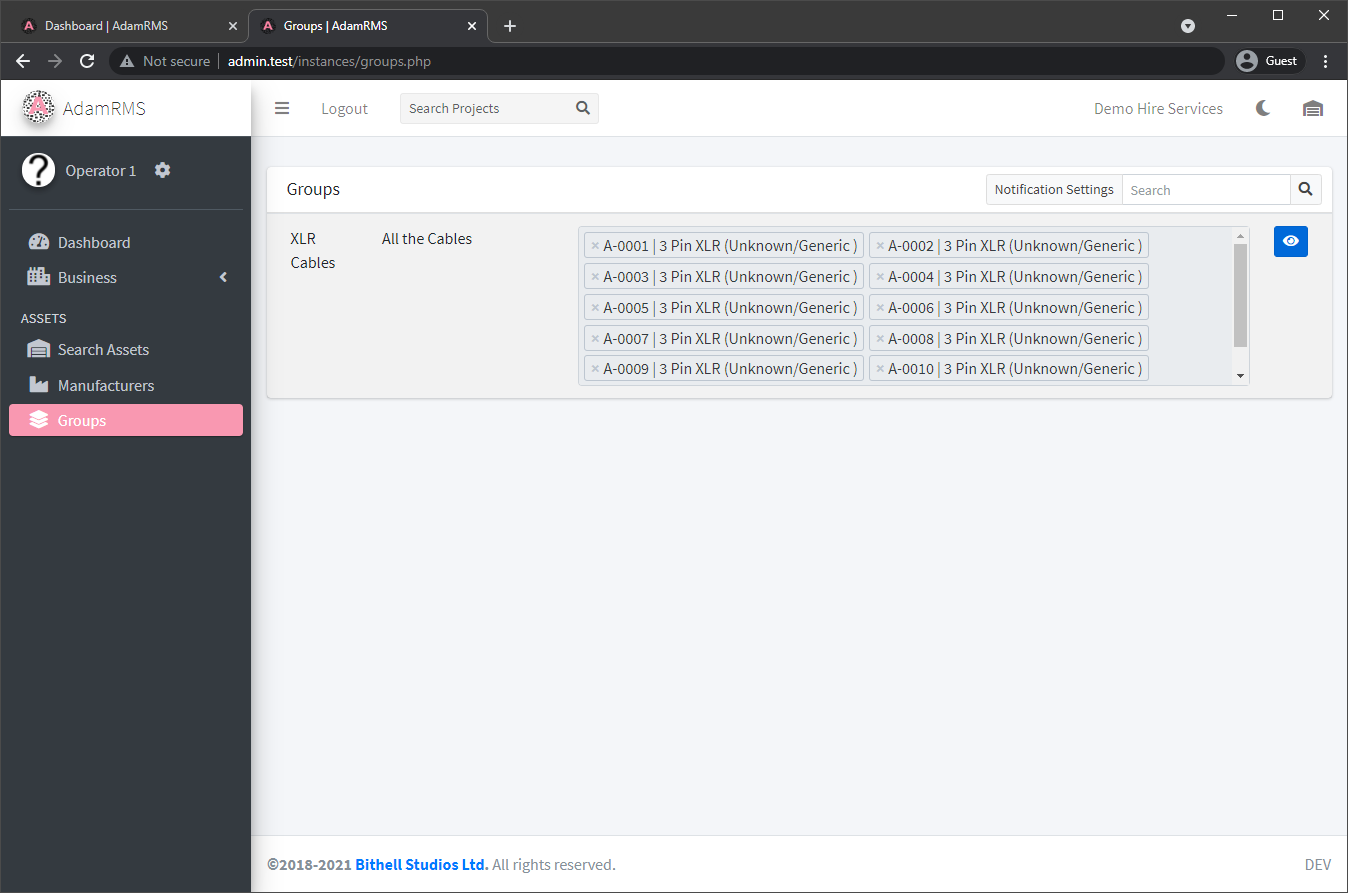 Group Listing
ASSETS:ASSET_GROUPS:CREATE
ASSETS:ASSET_GROUPS:EDIT
ASSETS:ASSET_GROUPS:DELETE:ASSETS_WITHIN_GROUP
ASSETS:ASSET_GROUPS:EDIT:ASSETS_WITHIN_GROUP
Creating a Group
- In the side menu, under ASSETS, click Groups to open the Asset Groups page.
- Click the + button.
- Enter a group name and description.
- Optionally tick Visible to only me to make the group personal (unticked groups are visible to all users in the business).
Adding Assets to a Group
Assets can be added to groups in two ways:
- From the groups page -- select assets to add to an existing group.
- From an individual asset's page -- use the edit form on a specific asset to assign it to one or more groups.
An asset can belong to multiple groups simultaneously.
Watching Groups
You can watch a group to receive email notifications whenever:
- An asset is added to or removed from the group
- An asset in the group is assigned to or removed from a project
This is useful for keeping track of equipment that you're responsible for, without needing to manually check for changes.
Notification preferences for group watching can be customised from your account page. You can enable or disable individual notification types for watched groups.
Assigning a Group to a Project
If you have permission to assign assets to projects (PROJECTS:PROJECT_ASSETS:CREATE:ASSIGN_AND_UNASSIGN), you can assign all assets in a group to a project in one step. This is much faster than adding assets individually when you have a standard kit list.
Filtering by Group
Groups can be used as a filter in the asset search. Select one or more groups in the search filters to show only assets belonging to those groups.
Use Cases
- Kit lists -- create groups for standard event setups (e.g. "Festival PA Rig", "Conference AV Pack") so you can assign them to projects quickly.
- Purchase batches -- group assets by purchase date to track warranty periods or depreciation.
- Personal tracking -- create private groups to keep a shortlist of assets you're responsible for or working with.
- Cable runs -- group cables and connectors for specific venue setups.
Related Features
- Assets -- understanding asset types and individual assets
- Finding Assets -- filtering assets by group in search
- Asset Barcodes -- generating barcode sheets by group
- Project Assets -- assigning assets to projects